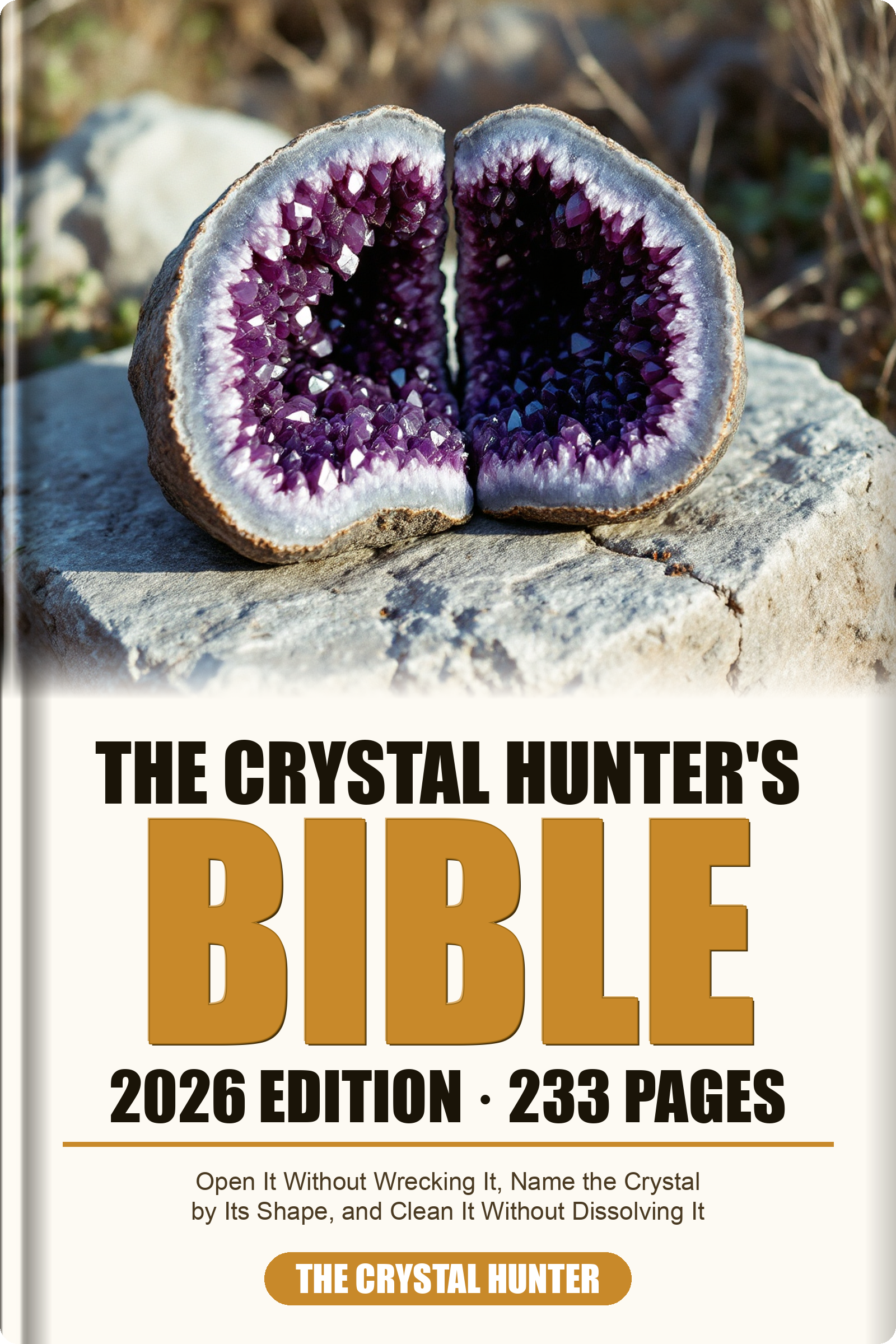
What Happens After You Pick It Up
Two searches of the Amazon book store, on the same afternoon, returned nothing at all. How to clean mineral specimens crystals — no results. Crystal identification habit mineral collector — no results. Meanwhile a kit for smashing ten geodes sells at thirty-one dollars and carries 32,015 ratings on that one listing, and the wet saw that would open them properly costs a hundred and sixty-nine. Between the kit that destroys them and the saw that opens them there is no product, at any price, that teaches the decision in the middle.
$49$27
$27 — the book, one PDF, delivered to your inbox
Secure Stripe checkout · the PDF arrives by email within a minute · 60-day First Specimen Guarantee, and you keep the file
Nobody connected with this book claims to have opened anything, and there is not one field anecdote in it. Every load-bearing sentence carries a named source with the date it was read, and every chapter ends with a section called Check me that lists them by author, publication, edition and date.
This is not a positioning claim. It is a search box, and the searches are free.
The only title in the entire store whose declared subject is how to open a geode is a children's book of thirty-two pages, at $9.99, with 3.6 stars. The buyer who wants the adult version of that answer has three options today: a photo book from twenty years ago, a forum thread where six people hand him six mutually incompatible chemicals, or a video where somebody pours acid without gloves and the comment section corrects him.
So the money in this hobby goes somewhere else. It goes on the kit, and on the tumbler, and on the saw. What nobody has ever sold is the half hour between the stone landing on the bench and the first irreversible thing you do to it — which is exactly the half hour that decides whether you still have a specimen at the end of it.
Not one of these is bad luck, and not one of them is carelessness. Every one is a reasonable decision made with the wrong information, and each maps to the chapter that fixes it.
You had read the same three product names everywhere, so you picked one. The piece fizzed, and you took the fizzing for cleaning. It was not cleaning. Calcium carbonate and hydrochloric acid give you calcium chloride, water and carbon dioxide — those bubbles were your calcite going down the drain, and the aragonite, the dolomite and the agreeable limestone matrix went with it. Muriatic acid is not the universal cleaner of this hobby. It is a selective tool for taking carbonates off, and if the carbonate was the specimen, it is not cleaning, it is disposal.
Chapter 10: Identify It Before You Wet It. And Chapter 11: Oxalic, Muriatic and Iron Out: The Numbers Nobody Gives You. Strengths, temperature ceilings, check intervals, elapsed times — and the room the acid does not enter at all.
You put it on the concrete and hit it. There was no cleavage plane inside to guide the crack, so the energy left by whichever flaw was most convenient — the microfissures in the rind, the banding, the contact between rind and crystal lining — and it took the terminations with it on the way out. The forum thread that everybody in this hobby eventually finds is titled, in as many words, cracking, not smashing. Nobody has ever written down what the difference actually consists of.
Chapter 3: Where It Breaks Is Your Decision, Not the Rock's. The mechanism first, then the method: score the line around the equator, walk a cold chisel along the scored path instead of hitting one spot, tap rather than smash, contain the fragments — and the impact rating that chiseling actually requires, which is printed on the lens and takes two seconds to check.
Somebody on a forum said it would work. It arrived, and it will not take a fist-sized stone: a seven-inch tile saw cuts about an inch and a quarter of height, which is a number that today exists nowhere except buried in one thread. The band saw is not meant for anything thicker than about a quarter inch. The tailpipe version of the chain cutter has nowhere near enough leverage. And the machine you did buy runs on the wrong coolant, which is its own separate way of wasting the money twice.
Chapter 4: The Chain, the Wet Saw, and Three Machines That Are Not For This. The tool decision made with cut heights, blade limits and coolant by machine — and with no prices anywhere in it, because tool prices date within months and you can check them yourself in two minutes.
It is the way the whole retail side of this hobby is built, and it is backwards. The Handbook lists quartz as colorless, white, rose-pink to rose-red, yellow to yellowish brown, green, blue, bluish violet, brown to black, zoned or mottled — eleven color words for one single mineral in one line, and zoned or mottled on top of that, and every one of them caused by an inclusion or a defect rather than by the mineral itself. Color is the impurity. Habit is the fingerprint. Name it by color and you will reach for the wrong bottle, and the wrong bottle is chapter one of this list.
Chapter 7: Habit Is the Fingerprint. Color Is an Impurity. Then Chapter 8: Sixteen Minerals That Actually Come Out of a Cavity. And Chapter 9: The Six Pairs That Fool Everyone. Quartz against calcite, baryte against celestine, pyrite against marcasite — one deciding test per pair, and none of them is color.
Everybody in this hobby says cut wet, and cutting wet is genuinely better. It is not a safe harbor. In the federal countertop measurements, across twenty-two wet-cut samples the shift median was 54 micrograms per cubic meter against a permissible limit of 50, the range ran from 15 to 134, and 55 percent of them were over the limit. What you are cutting sits at the very top of the silica table — a geode is essentially pure silicon dioxide, well above granite. Between January 2019 and June 2026 California identified 592 silicosis cases among stone workers, 65 of whom received a lung transplant and 31 of whom died.
Chapter 5: Wet Is Not Safe: The Dust That Doesn't Warn You. The limits with the regulation cited, the measured numbers dry and wet, and the combination that actually moved them — water at the point of contact, wetting the piece first, extraction or open air, and never sweeping dry afterwards.
You did everything right in the afternoon and lost it over the following decade. Pyrite and marcasite are the same iron disulfide in two different crystal systems, and marcasite oxidizes first; the reaction gives off sulfuric acid, which attacks the box, the labels and the specimens sitting next to it. The federal conservation manual puts it in one line: the damage is preventable, but irreversible once it begins. Meanwhile the amethyst on the windowsill is dying in the one place in the house that is worst for it, because window glass blocks the UV-B and passes plenty of UV-A.
Chapter 13: Ten Years From Now: Pyrite Disease, Faded Amethyst, and the Label. The humidity numbers before and after the reaction starts, why sealing a sick piece makes it worse, the species that change in the dark, and the label system that decides whether you own a collection or a bucket of pretty rocks.
This is an audience that corrects mineralogy in public and gets hundreds of likes for it. The only way to earn the right to be believed about an acid concentration is to say the duller true thing first, repeatedly, where it costs something.
It is a selective tool for removing carbonates, and it does that job well. The reaction is written out in the book so you can see what leaves: calcite, aragonite, dolomite, and the limestone matrix along with them. Its legitimate use is stripping a carbonate crust that is hiding something else. Every other use of it in this hobby is somebody dissolving the specimen he was trying to reveal.
Not the water, not the rock, not bad luck. Push the concentration or the time and a far less soluble form of iron comes out of solution and plates onto the piece. The book gives the three documented ways back — one of which takes weeks or months — and the contact-and-rinse discipline that stops it happening at all. This is the single most-asked unanswered question in the niche, and it has been sitting in comment sections for years with zero replies under it.
Fifty-five percent of the measured wet-cut samples were over it. The number that matters is not wet against dry, it is the whole combination, and the book gives the measured effect of each part of it. The respirator is the last rung of the hierarchy of controls and not the first, and a respirator that is actually protecting anybody comes with a fit test and a medical evaluation — the loose mask in the drawer is not a plan.
Not a crystal. It is a direct consequence of perfect cleavage in four directions, and it is separable in the hand with a lens: flat, smooth, specular cleavage faces against the rougher surfaces, rounded edges and growth marks of one that actually grew that shape. The book teaches you to see it. It does not tell you what either one is worth, because no honest book can.
Not the state geological survey, not anybody. So this book says so in chapter one and refuses to give you a proportion — and it says plainly that whoever quotes one in a video is inventing it. Saying that in the first ten pages is what buys the right to be trusted three hundred pages later, when the number does exist and is worth having.
Delivered in the same file: One Stone, One Evening, a walkthrough that puts fourteen chapters' worth of decisions in the order an actual evening runs, on one object, from the doorstep to the label. Tonight, or First Buy Something, which sorts the whole book by what it costs — what you can do in the next hour with what is already in the house, and what genuinely has to be bought or rented first. A mineral index that gets you from a species name to the pages where that species changes what you do.
The first appendix, Can I Take This Home? Four short lines on what the federal phrase reasonable amounts does and does not mean, the national-park prohibition with no exception, the Forest Service devolving the real rule to the individual forest, and the owner's permission on private land — ending in the phone call that settles it. It is deliberately not a permissions system, and it says so on the page.
The second appendix, Check Me. Every source by name, edition and date, with how to reach it for nothing — followed by the printed list of what nobody has published at all.
The reviews that kill a book in this category all say the same thing: it promised something it did not have. So here is the list, before you pay rather than after.
There is not one grid reference in it and not one go here. Site lists age in a season and they teach nothing that survives the trip. What is here instead is the object already in your hand. The first appendix is four lines on whether that object was yours to carry off, and it ends by telling you to phone the office that manages that specific piece of ground, because that call is the only thing that settles it.
Not a dollar figure, not a comparison of one species against another. What a specimen is worth depends on its size, its species, the condition of its terminations, how much matrix it kept and how much damage it took — and any single number printed in a book would be invented. What the book can tell you is whether the orange in a quartz crystal came out of an oven.
A saw hands you a flat face that reads: the banding continuous across it, the section legible. Getting the blade marks out after that is grinding and then polishing — a trade with its own machines, its own consumables, its own sequence and its own literature. No source read for this book publishes an abrasive sequence, a speed, a time or a compound, so none appears in it, and the word polishable is never used as a reason to reach for a saw. It is also, by the published numbers the book cites, the step with the worst dust figures in the hobby.
Nobody has published what fraction of these things are hollow, so nobody can honestly quote you odds — and this book refuses to, in chapter one, in writing. What it can do is make sure that on the day a good one is sitting in front of you, the thing that opens it is a decision rather than a swing.
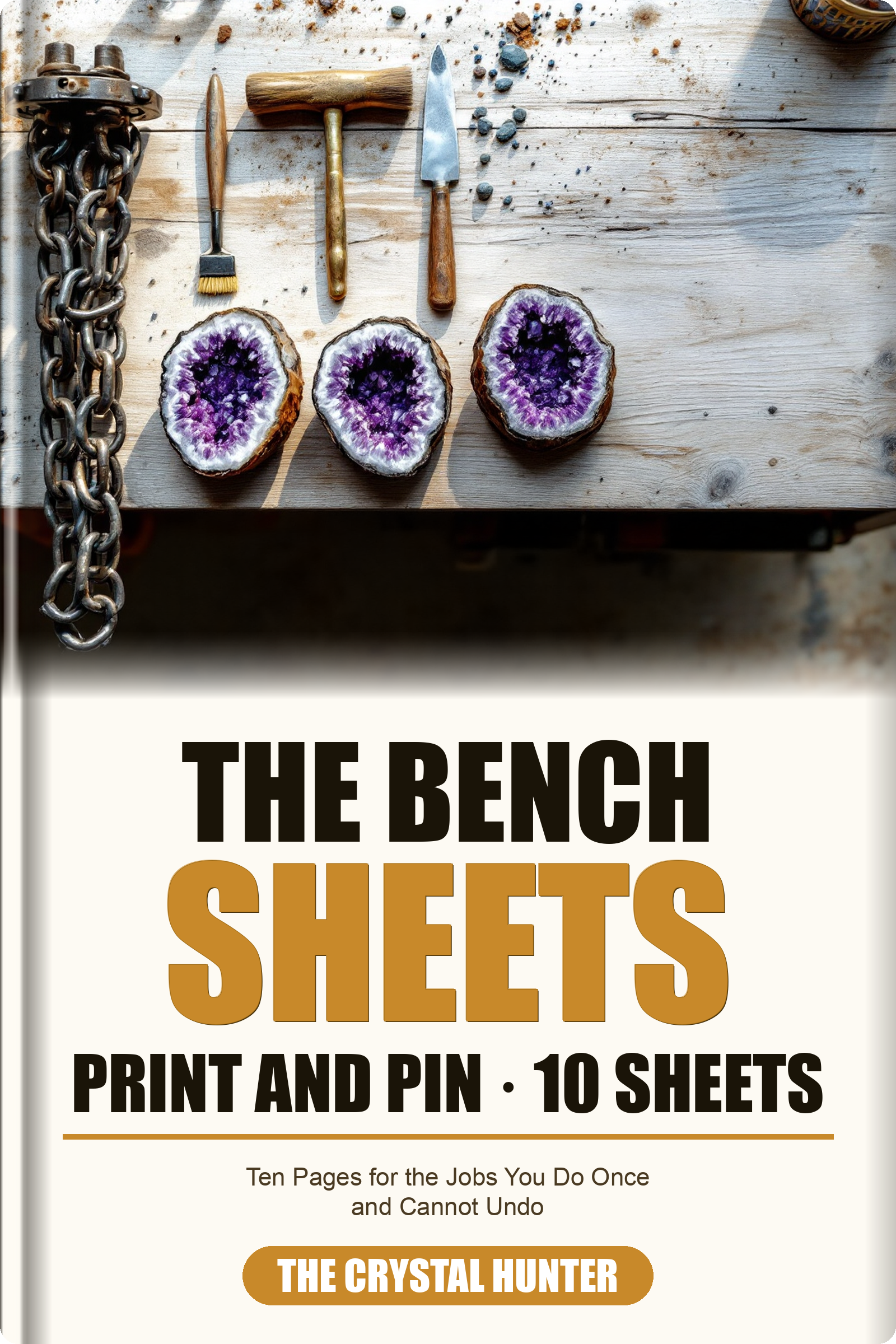
Ten print-and-pin pages for the jobs you do once and cannot undo.
The book is why. The sheets are what you pin at eye level when your hands are wet and you are not going to page through 233 pages to check a temperature. US Letter, portrait, black-ink friendly, made to be taped inside a cabinet door — plus one fill-in sheet meant to be photocopied. Ten sheets, 14 pages including the cover and the source list.
It is bench paper, not field paper — for a room with power, light and a sink. Tick the box in the price panel above and it is one payment and one checkout; you will get two files instead of one.
Both anchors below are prices observed in this market on 2 September 2026 — not invented numbers with a line drawn through them.
| A collector monograph on one species | Ninety-six pages, hardback, one mineral, from a series that has five of them. Excellent, and it covers a fraction of one chapter of this book. | $19.99 |
| A laminated identification field guide | Forty-four laminated pages, the best-reviewed reference object in this hobby, sold as much on surviving the weather as on what is printed inside it. | $29.95 |
| A second laminated guide, for the bench | The same series sells thirteen of these at one price, and this is what a set of wipe-clean reference sheets costs when somebody laminates it for you. It is the comparison for The Bench Sheets, and it only applies if you tick the box. | $29.95 |
| Both, at what they actually cost | And with both of them on the bench you still do not know where the line goes, which acid is safe on this piece, or what to do about the yellow. | $49.94 · $79.89 with the sheets |
| The Crystal Hunter's Bible | 233 pages on the half nobody wrote — with the numbers, the sources and the dates. | $27 |
The $49 struck through at the top of this page is that total, rounded down. Tick the box for the sheets and it becomes $79, because the thing you just added has its own price on the shelf and it would be sleight of hand to leave the comparison where it was. It is a comparison and not a discount: nothing here was ever sold at $50, and there is no timer on this page, because the one digital seller in this niche who anchored permanently with a struck-through price has spent over a year being worth five dollars. For what it is worth against the rest of the shelf, $27 is less than a year of the magazine this buyer already renews, less than the identification app he already pays for annually, and about what he last spent on a bag of rough he intends to destroy.
This is a first edition and there are no reader reviews yet. When there are, they will appear here with the reader's name, his state and the chapter he is talking about, and with a note saying whether he received an advance copy.
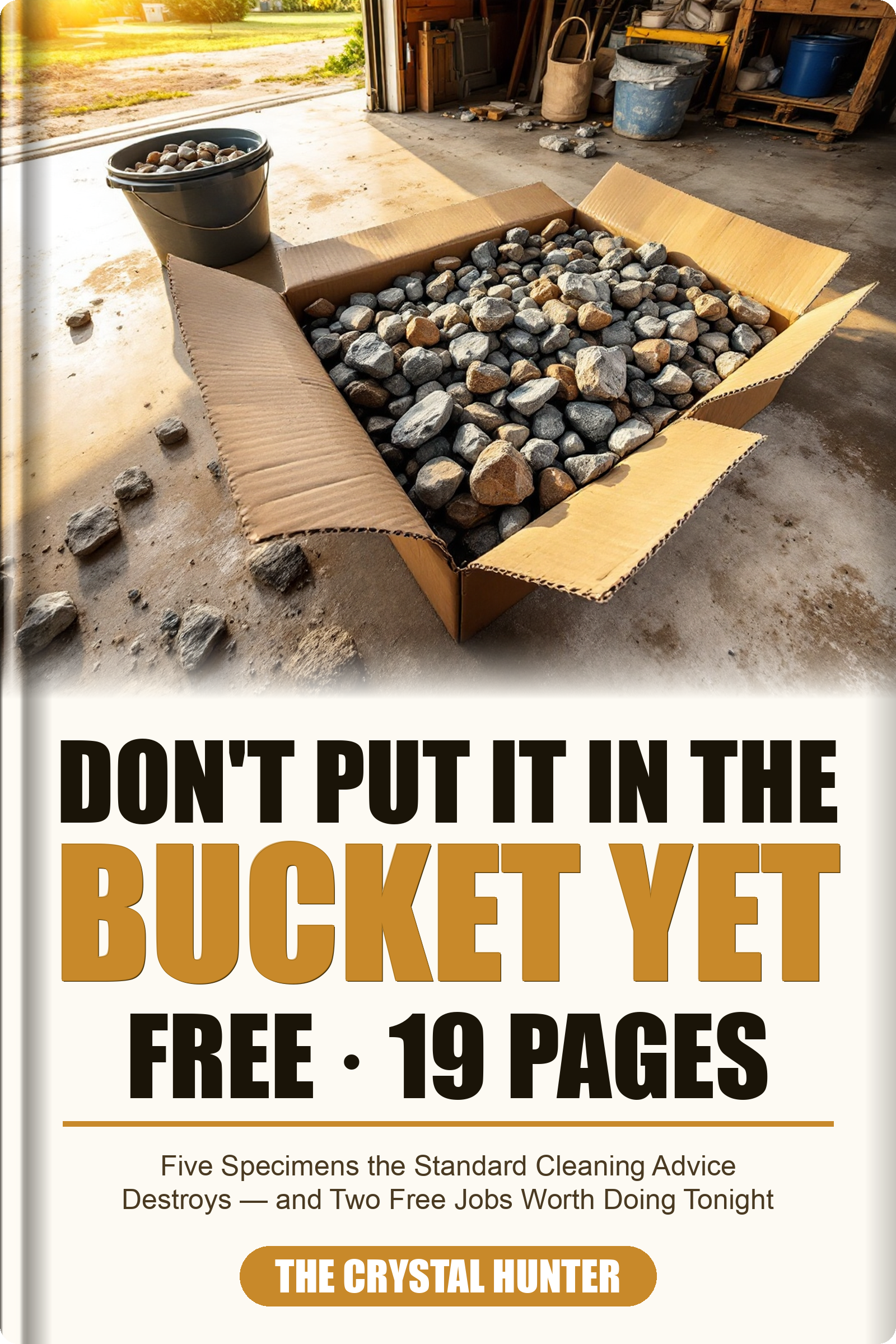
Five Specimens the Standard Cleaning Advice Destroys, and Two Free Jobs Worth Doing Tonight
There is a box in your garage. Before you touch a single bottle, this runs one procedure end to end over what is already in it: the two-minute triage that decides which acid would destroy a piece instead of cleaning it, the five that never go in an ultrasonic tank and the two that never go in plain water at all, the never-mix page quoted from a manufacturer's own safety sheet with its date, what to do with the bucket of used chemical water — which is the most-liked unanswered question in this niche — and the two jobs that cost nothing and are genuinely urgent tonight.
Every page carries its source by name and the date it was checked. It teaches only what not to do and what is urgent: there is not one cleaning procedure, concentration, temperature or elapsed time in it, and it says so on the last page.
No cost, no card. One email with the PDF, then three short ones over the following nine days — why the fizz test decides everything that comes after it, the measurements that show cutting wet does not put you under the silica limit, and a plain account of who the book is not for. Unsubscribe in one click.
Would rather read about it first? Here is what is in it, page by page.
No. It is a single PDF of 233 pages, fourteen chapters and two appendices, delivered to your email within a minute of checkout, and it opens on a phone, a tablet or a computer. Nothing ships and there is nothing to wait for. If you tick the box for The Bench Sheets at checkout, that is a second PDF of 14 pages, laid out for US Letter so you can print it and pin it above the bench.
No, and it says so on the cover rather than in the small print. There are no localities, no coordinates, no directions and no land-access system in it, by decision and not by omission. This book is about the object after you already have it. The one thing it does say about ground is the appendix called Can I Take This Home?, which is four short lines on whether the piece on your bench was yours to carry off, ending in the phone call that settles it — and it states plainly that it is not a permissions system.
Because the videos are not the problem, and several of them are considerably better than what is in print. The problem is that the questions this hobby actually asks need numbers — what strength, how hot, how long, how dry — and a number is the one thing a video cannot hand you at the bench with wet hands. Watch a hundred of them and you will still find that nobody gives a concentration, nobody gives a soak time, and the man asking what kind of vinegar was used has been waiting a long time for an answer. The comment sections are where this hobby corrects itself, and they are the reason this book prints its sources: it is the same instinct, sitting still, searchable, with the date attached. Watch the videos. Then have the thing that does not scroll away.
No, and no honest guide can. Value depends on size, species, the condition of the terminations, the matrix and the damage, and any fixed number printed in a book would be invented. Chapter 14 does something more useful: it teaches you to see the treatment. Heated amethyst sold as citrine comes out intensely orange, often with a whitish milky base and the saturated color concentrated in the tips, while natural citrine is pale — champagne, soft honey, light gold. In yellow quartz, vivid color is a sign of the oven and not of quality. The book teaches you to recognize it; it never says what it is worth.
Yes, and it was written that way on purpose. Chapter 3 is built around the hammer and the cold chisel, because that is what is actually on most benches, and because two separate people asked for exactly that method on the same video and never got an answer. Chapter 4 gives the tool decision with cut heights and coolants and no prices at all. And there is a page at the back that sorts the entire book by what it costs: what you can do tonight with what is already in the house, and what genuinely has to be bought or rented before it is worth touching anything.
No, and that is a deliberate refusal rather than an oversight. A blade gives you a flat face that reads; taking it further is grinding and polishing, which is a separate trade with its own machines and its own literature, and no source consulted for this book publishes an abrasive sequence, a speed, a time or a compound. Selling you the word polishable as a reason to buy a saw and then handing you no procedure for the step it points at would be exactly the half-promise this book convicts everybody else of. It is also the step with the worst measured dust numbers in the hobby, which is its own reason not to gesture at it.
Nobody connected with this book claims to have opened, cut or cleaned anything, and there is not one field anecdote in these pages. It was assembled from published sources with the assistance of artificial intelligence — which is precisely why every load-bearing sentence carries a named source with the date it was read, why the four tags exist, and why the Check Me appendix is as long as it is. You are not being asked to trust an author. You are being handed the sources so you can go and check them, and told in writing which claims could not be checked at all.
Take one piece you already own. Run chapter 7 to name it and chapter 10 to decide what may touch it. If the book does not change what you were about to do to that specimen, reply to your receipt or write to mysteriesmediallc@gmail.com within 60 days and you get every cent back. No form, no questions, and you keep the file — a PDF cannot be handed back, and pretending otherwise would be theater. The refund covers The Bench Sheets too, whether you took them at checkout or afterwards.
The hammer falls in a second, the calcite is gone in a minute, and the pyrite takes ten years. All three are decisions, and all three are made before you touch the thing.
$49$27
$27 — the book, one PDF, delivered to your inbox
Secure Stripe checkout · the PDF arrives by email within a minute
The two-minute triage that decides which acid would destroy a piece instead of cleaning it, the five that never go in an ultrasonic tank, and the two jobs that cost nothing and are urgent tonight. It needs no purchase, no trip and no tool you do not already own.
No cost, no card. Unsubscribe in one click.